Sunday, August 17, 2025

Agriculture Class 10

 Textbook Questions 

Q1. Name one important beverage crop and specify the geographical conditions required for its growth.
Ans: Tea is an important beverage crop. Geographical conditions: 

  • Tropical and sub-tropical climates endowed with deep and fertile well-drained soil so rich in humus and organic matter.
  • Temperature: 20°C -30°C.
  • Annual rainfall: 150-300 cm.
  • Frequent showers evenly distributed over the year.

Q2. Name one staple crop of India and the regions where it is produced.
Ans:

  • Rice is a staple crop of India.
  • Regions, where it is produced, are plains of north and north-eastern India, coastal areas and deltaic regions, i.e., West Bengal, Uttar Pradesh, Andhra Pradesh, Punjab and Tamil Nadu.

Q3. Enlist the various institutional reform programmes introduced by the government in the interest of farmers.
Ans: Institutional reforms: 

  1. Minimum Support Price (MSP)
  2. Subsidies on fertilisers
  3. Crop insurance against draught, flood, etc.
  4. Establishment of Grameen banks, cooperative societies and banks to provide loans at lower rates of interest. 
  5. Kissan credit cards

Answer the following questions in about 120 words

Q1. Suggest the initiative taken by the government to ensure the increase in agricultural production.
Ans:

  • To ensure an increase in agricultural production, the government prioritised collectivisation, consolidation of holdings, cooperation and abolition of the zamindari system. 
  • 'Land reform' was the main focus of the First Five Year Plans. In the 1960s and 1970s, agricultural reforms were the order of the day. 
  • The Green Revolution and the White Revolution (Operation Flood) were aimed at improving Indian agricultural productivity.
  • During the 1980s and 1990s, a comprehensive land development programme was initiated. 
  • Under this, various technical and institutional reforms were introduced by the government for the benefit of farmers.
    Example: Minimum Support Price policy, provision for crop insurance, subsidy on agricultural inputs and resources, Grameen banks, Personal Accident Insurance Scheme, and special weather bulletins and agricultural programmes like 'Krishi Darshan' on national television.

Q2. Describe the geographical conditions required for the growth of rice.
Ans:

  • Rice is a Kharif crop grown in the onset of monsoon and harvested in September-October.
  • It is grown in plains of north and north-eastern India, coastal areas and deltaic regions. 
  • In India, important rice growing regions are Assam, West Bengal, coastal regions of Odisha, Andhra Pradesh, Telangana, Tamil Nadu, Kerala and Maharashtra, particularly the (Konkan coast) along with Uttar Pradesh and Bihar.
  • It requires high temperatures (above 25°C) and high humidity with annual rainfall above 100 cm. 
  • In areas with less rainfall, it grows with the help of irrigation via canals and tube-wells. This has made production of rice possible in areas such as Punjab, Haryana and western Uttar Pradesh, and parts of Rajasthan.

Tuesday, August 5, 2025

Class 10 ch 3 Gender religion and caste

 Textbook questions 

Q.Mention different aspects of life in which women are discriminated or disadvantaged in India.

Q1. Ans: Women in India face discrimination and disadvantage in the following ways:


a. They are not given a proper education. As a result, the literacy rate among women is only 54%.


b. The majority of their work is unpaid. Where they are compensated for their labour, they are paid less than men.


c. Female foeticide is prevalent in several parts of the country due to a preference for the boy child.

d)Many women face sexual harassment and domestic violence, which makes it hard for them to follow their dreams. This happens because people often see women as physically weaker, there is not enough support from the police, and society is largely male-dominated.

Q2. State different forms of communal politics with one example each.

Ans: Different forms of communal politics:


1The expression of communal superiority in everyday beliefs.This involves religious prejudices, stereotypes of religious communities and a belief in the superiority of one’s religion over other religions.

Example: Militant religious groups.

2.The desire to form a majoritarian dominance or a separate state.A communal mind often leads to a quest for political dominance of one’s religion over another in a community. It takes a form of majoritarian dominance.

Example: Separatist leaders and political parties in Jammu and Kashmir and Central India.

3.The use of religious symbols and leaders in politics to appeal to the voters.Political mobilisation on religious lines is another frequent form of communalism. Political parties, generally, nominate their candidates according to the caste or religion dominant in a particular constituency

Example: Hate speeches against particular minorities during elections.

4.Communal violence is another form of communalism in politics. For example, the anti-Sikh riots in 1984.The riots in Gujarat in 2002.


Q3. State how caste inequalities are still continuing in India.
Ans: Caste inequalities are still continuing in India in the following ways:

  1. Most people still marry within their own caste or tribe, and inter-caste marriages are often discouraged, especially by upper castes.
  2. Despite being banned by the Constitution, untouchability persists, particularly in rural areas.
  3. Groups with historical access to education continue to excel, while those previously excluded still lag behind.
  4. Caste contributes to economic inequality, as it affects access to resources. Upper castes are best off, Dalits and Adivasis are worst off, with the backwards classes in between.
  5. Although every caste has some poor members, the proportion of people living in extreme poverty is much higher for the lowest castes. Lower caste people, like rural landless labourers, are generally poor and are exploited even today. 

Q4. State two reasons to say that caste alone cannot determine election results in India.
Ans: Caste alone cannot determine election results in India because:

  1. No parliamentary constituency has a clear majority of a single caste. Hence, every candidate and party needs to win the support of more than one caste/community to win elections.
  2. No party wins all the votes of a particular caste. When it is said that caste is a 'vote bank' of one party, it means that a large proportion of the voters from that caste vote for that party.

Q5. What is the status of women’s representation in India’s legislative bodies?
Ans: The status of women’s representation in India’s legislative bodies is very less as mentioned below:

  1. In Lok Sabha, the percentage of elected women members is less than 15 per cent of its total strength.
  2. Their share in the state assemblies is less than 5 per cent. India is among the bottom group of nations in the world in this respect.
  3. The proportion of women in legislative bodies has been very low. Because of the demand of Women’s organisations and activists ,In 2023, Nari shakti Vandan Adhiniyam (Womens’ Reservation Act, 2023) has been passed which will give 33 percent reservation of seats for women in Lok Sabha, State Legislative Assemblies and also Delhi Assembly.

Q6. Mention any two constitutional provisions that make India a secular state.
Ans: Two constitutional provisions that make India a secular state are:

  1. The Constitution provides all individuals and communities freedom to profess, practice and propagate any religion, or not to follow any.
  2. The Constitution prohibits discrimination on the grounds of religion.

Q7. When we speak of gender divisions, we usually refer to:
(a) Biological difference between men and women
(b) Unequal roles assigned by society to men and women
(c) Unequal child sex ratio
(d) Absence of voting rights for women in democracies
Ans: (b) Unequal roles assigned by society to men and women

Gender division usually refers to the societal assignment of unequal roles, responsibilities, and expectations to men and women, which often leads to inequality and discrimination


 Q7. When we speak of gender divisions, we usually refer to:

(a) Biological difference between men and women
(b) Unequal roles assigned by society to men and women
(c) Unequal child sex ratio
(d) Absence of voting rights for women in democracies
Ans: (b) Unequal roles assigned by society to men and women

Gender division usually refers to the societal assignment of unequal roles, responsibilities, and expectations to men and women, which often leads to inequality and discrimination


Q8. In India, seats are reserved for women in
(a) Lok Sabha
(b) State Legislative Assemblies
(c) Cabinets
(d) Panchayati Raj bodies
Ans: (d) Panchayati Raj bodies

In India, seats are reserved for women in Panchayati Raj bodies, which are the rural local government institutions. This reservation aims to promote women's participation in local governance.


 Q9. Consider the following statements on the meaning of communal politics. Communal politics is based on the belief that:

Α. One religion is superior to that of others.
Î’. People belonging to different religions can live together happily as equal citizens.
C. Followers of a particular religion constitute one community.
D. State power cannot be used to establish the domination of one religious group over others.
Which of the statements is/are correct?
(a) A, B, C and D
(b) A, B and D
(c) A and C
(d) B and D
Ans: (c) A and C

Communal politics is based on the belief that one religion is superior to others and followers of a particular religion form one community. Statements Î’ and D represent principles of secularism and equal citizenship, which are contrary to communal politics.

Q10. Which among the following statements about India’s Constitution is wrong? It
(a) prohibits discrimination on grounds of religion
(b) gives official status to one religion
(c) provides to all individuals freedom to profess any religion
(d) ensures equality of citizens within religious communities
Ans: (b) gives official status to one religion

India’s Constitution does not give official status to any religion; it promotes secularism and prohibits discrimination based on religion. 

Q11. Social divisions based on ______________ are peculiar to India.
Ans: Social divisions based on caste are peculiar to India.

 Caste


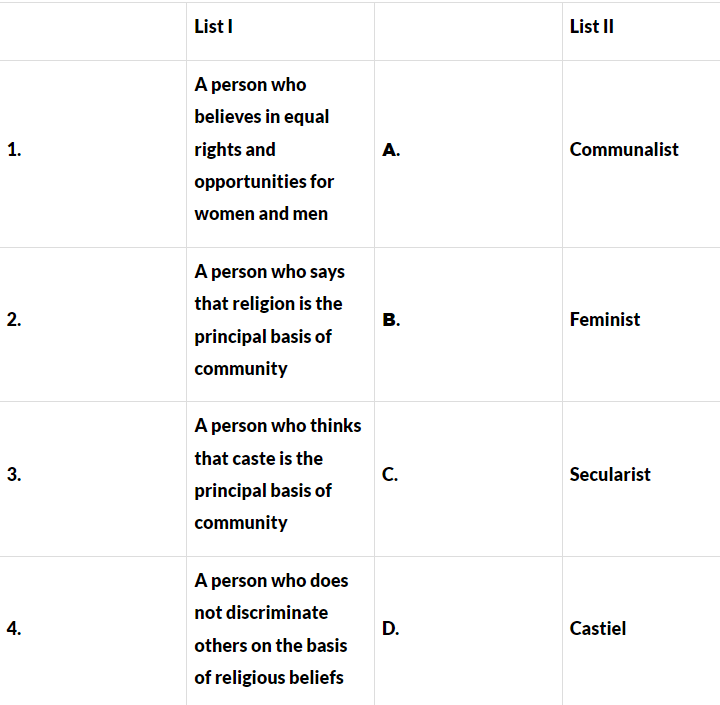
Q12. Match List I with List-II and select the correct answer using the codes given below the Lists:


Ans b 1b ,2A, 3D,4C 


Thursday, July 17, 2025

Class 9 Drainage


DRAINAGE 


 Q1. Choose the right answer from the four alternatives given below.

(i) In which of the following states is the Wular lake located?

(a) Rajasthan

(b) Uttar Pradesh

(c) Punjab

(d) Jammu and Kashmir

Ans: (d) Jammu and Kashmir state.

ii) The river Narmada has its source at

(a) Satpura

(b) Brahmagiri

(c) Amarkantak

(d) Slopes of the Western Ghats

Ans: (c) Amarkantak

(iii) Which one of the following lakes is a salt water lake?

(a) Sambhar

(b) Dal

(c) Wular

(d) Gobind Sagar

Ans: (a) Sambhar

(v) Which one amongst the following rivers flows through a rift

valley?

(a) Mahanadi

(b) Tungabhadra

(c) Krishna

(d) Tapi

Ans: (d) Tapi

Q2. Answer the following questions briefly.

(i) What is meant by a water divide? Give an example.

Ans: A water divide is an elevated area, such as a mountain or an upland,

that separates two drainage basins. For example western Ghat, Vidhyachal moutain range .

(ii) Which is the largest river basin in India?

Ans: The Ganga River basin is the largest one in India. The length of this

basin is over 2,500 km.

(iii) Where do the rivers Indus and Ganga have their origin?

Ans: The Indus originates in Tibet, near Mansarovar Lake. The Ganga

River originates at the Gangotri Glacier on the southern slopes of the

Himalayas.

(iv) Name the two headstreams of the Ganga. Where do they meet to

form the Ganga?

Ans: The two headstreams of the Ganga are the Bhagirathi and the

Alaknanda. They meet to form the Ganga at Devaprayag in Uttarakhand.

(v) Why does the Brahmaputra in its Tibetan part have less silt,

despite a longer course?

Ans: The Brahmaputra in its Tibetan part, carries a smaller volume of water

and less silt as it is a cold and dry area.

(vi) Which two Peninsular rivers flow through trough?

Ans: The Narmada and the Tapi are the two peninsular rivers that flow

through the trough.

(vii) State some economic benefits of rivers and lakes.

Ans: Economic benefits of rivers:

i● Rivers provide water, which is a basic natural resource for various

human activities.

ii● They are used for irrigation, navigation, and generation of

hydroelectric power.

iii● They have a moderating influence on the climate of the

surroundings and maintain the aquatic ecosystem.

Economic benefits of lakes:

i● They help to regulate the flow of a river.

ii● They prevent flooding at times of heavy rainfall and during the dry

season, they help to maintain an even flow of water.

iii● They also have a moderating influence on the surrounding climatic

conditions and maintain the aquatic ecosystem.

iv● They enhance natural beauty and recreational activities by

encouraging tourism.

v● Lakes are also used for the generation of hydroelectricity.

Q3. Below are given names of a few lakes of India. Group them under

two categories − natural and created by human beings.

(a) Wular

(b) Dal

(c) Nainital

(d) Bhimtal

(e) Gobind Sagar

(f) Loktak

(g) Barapani

(h) Chilika

(i) Sambhar

(j) Rana Pratap Sagar

(k) Nizam Sagar

(l) Pulicat

(m) Nagarjuna Sagar

(n) Hirakund

B

(a) Wular

(b) Dal

(c) Nainital

(d) Bhimtal

(f) Loktak

(g) Barapani

(h) Chilika

(i) Sambhar

(l) Pulicat

Lakes created by human beings

(e) Gobind Sagar

(j) Rana Pratap Sagar

(k) Nizam Sagar

(m) Nagarjuna Sagar

(n) Hirakund

Q4. Discuss the significant difference between the Himalayan and the

Peninsular rivers.

Ans:

The Himalayan Rivers 

(i) They are perennial rivers. They get water from both the melted snow and heavy rainfall.

ii) They perform an immense erosional activity in the upper course.

(iii) They have long courses from their source to the mouth.

iv) They carry a large amount of silt and sand, which is renewed every year by annual floods. Therefore they are good for agriculture.

(v) The Ganga, the Indus, the Brahmaputra are major Himalayan rivers 

Peninsular Rivers 

(i) They are seasonal in nature. They depend on rainfall only.

(ii) They do not perform any erosional activity in the upper course.

(iii) They have shorter and shallower courses.


(iv) These rivers do not carry much silt, there are no major plains. Fertile lands are only found in the small delta areas.

(v) The Mahanadi, the Godavari, the Krishna, the Kaveri, the Narmada and the Tapi are major Peninsular rivers.

Q5. Compare the east-flowing and the west-flowing rivers of the

Peninsular Plateau.

Ans:

The East Flowing Rivers 

(i) The Mahanadi, the Godavari, the

Krishna and the Kaveri are the east-flowing rivers of Peninsular India.


ii) These rivers drain into the Bay of Bengal.

iii) These rivers form deltas on the east coast.

iv) These rivers have a developed and large tributary system.

The West Flowing Rivers

(i) The Narmada and the Tapi are the major west-flowing rivers of Peninsular India.


(ii) These rivers drain into the Arabian Sea.


(iii) These rivers form estuaries on the west coast.


(iv) These rivers are devoid of any developed tributary system


Q6. Why are rivers important for the country’s economy?

Ans: The rivers are important for the country’s economy due to the following reasons:

a)It is an important source of natural freshwater, which is required for

the survival of most animals, including humans.

b)River water is used for various purposes like domestic, industrial,

and agricultural purposes.

c)The presence of rivers boosts trade and commerce by helping in

the easy transport of goods. They are also a potential source of energy.

d)River water is also used to run hydroelectric dams.

e)It is also used for navigation and transport, thus important for commercial activities.

f)It also provides fishing and great scenic and recreational value.

Thus, serve as good tourist spots.


Wednesday, June 4, 2025

SECTORS OF INDIAN ECONOMY CLASS 10

 Sectors of Indian Economy 


Q6: Do you think the classification of economic activities into primary, tertiary, and secondary is useful? Explain how. 

Answer:

The classification of economic activities into primary, secondary, and tertiary sectors is helpful as mentioned below :

1.It provides information on how and where the people of a country are employed. For example in India in 2000, the share of the primary sector in employment was about 60 percent ie. more than other sectors.

2.It also helps in ascertaining as to which sector of economic activity contributes more or less to the country’s GDP and per capita income.

3.If the tertiary sector is developing much faster than the primary sector, then it implies that agriculture is depleting and the government must take measures to rectify this.

4.The knowledge that the agricultural profession is becoming unpopular or regressive can only come if we know which sector it belongs to.

5.It provides us information about employment conditions in different sectors. For example in India, the primary sector faces the problem of disguised unemployment. In this sector, more people are employed and even if some are removed, production will not be affected.

6.It provides us the information about progress in different sectors. For example, the importance of the tertiary sector has increased due to various factors need for basic services and the coming of IT services.


In view of the above factors, it is necessary to classify economic activities into three sectors for smooth economic administration and development.


Q7. For each of the sectors that we came across in this chapter, why should one focus on employment and GDP? Could there be other issues which should be examined? Discuss.

Ans:


1Employment and GDP are two of the most important factors in the development of a country. 

2.They help in determining two important things—per capita income and productivity.

3.Hence, in each of the three sectors, employment rate and status, as well as its contribution to the GDP, help us understand how that particular sector is functioning and what needs to be done to initiate further growth in it.

4.Other issues that should be examined: literacy rates, poverty and nutrition as well as basic health care facilities. 


Q9. How is the tertiary sector different from other sectors? Illustrate with a few examples.
Ans:

  • The tertiary sector is different from the other sectors because it does not manufacture or produce anything. 
  • For this reason, it is also known as the service sector.
  • It aids the primary and secondary sectors in development. 
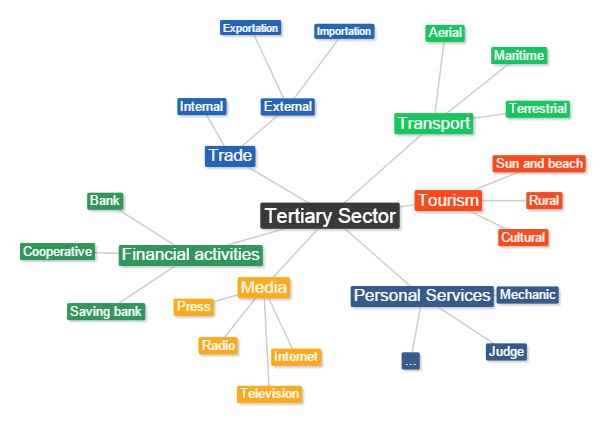
  • The tertiary sector involves services like transport, storage of goods, communications, banking and administrative work.


Q10. What do you understand by disguised unemployment? Explain with an example each from the urban and rural areas.
Ans:

  • Disguised unemployment is a form of underemployment where one has a job, but the work they are doing is less than their potential.
  • It is not apparent as compared to someone without a job who is clearly unemployed. 

  • In rural areas, this can be seen in the farming community where all members of a family might be working on a farm even though so many hands are not required. 
  • They do so because of lack of another job. In urban areas, disguised unemployment can be seen in the service sector where painters, plumbers, repair person and those doing odd jobs have work, but they may not find daily or regular employment.


Q11: Distinguish between open unemployment and disguised unemployment. 
•Open Unemployment – When a country’s labour force do not get opportunities for adequate employment, this situation is called open unemployment. This type of unemployment is generally found in the industrial sector of our country. This is also found among the landless agricultural labourers in rural areas.

  • On the other hand, disguised unemployment is mostly found in the unorganised sector where either work is not consistently available or too many people are employed for some work that does not require so many hands.
Q12: Tertiary sector is not playing any significant role in the development of Indian economy. Do you agree/ Give reasons in support of your answer? 
Answer:
“The tertiary sector is not playing any significant role in the development of Indian economy” is partially correct due to reasons as mentioned below :
•The share of tertiary sector in employment has not increased in proportion to its increase in production. In 2000, the production in service sector rose by 11 times, whereas employment has risen less than three times.
 Therefore, still more than half of the workers in the country are working in the primary sector.

•New services such as based on information technology have become important, but not all the services of the service sector are growing well. At one end are highly skilled and educated workers but on the other end, there are a very large number of workers engaged in services such as small shopkeepers, repair persons, transport persons. These persons barely manage to earn a living and yet they perform these services because no alternative opportunities for work are available to them. Such persons can not play any important role in the development of the Indian economy. It is this part of service sector that is not growing in importance.


Q13. Service sector in India employs two different kinds of people. Who are these?
Ans:
(i)  Highlight skilled and educated people: service sector in India employs them in multinational companies, public sector and several private enterprises. They are an asset as they add up high income in the National Income of the country.

(ii) Low skilled and less educated people: They are also employed in the service sector, but most of them are uneducated and work in unorganised sectors. They are employed as painters, plumbers, repairpersons, etc. 

Q14: Workers are exploited in the unorganized sector. Do you agree with this view.? Give reasons in support of your answer.

Answer:

Yes, workers are exploited in the unorganized sector. This would be clear from the following points:

1.There is no fixed number of working hours. The workers normally work 10 – 12 hours without paid overtime.

2.They do not get other allowances apart fro the daily wages.

3.Government rules and regulations to protect the labourers are not followed there.

4.There is no job security.

5.Jobs are low paid the workers in this sector are generally illiterate, ignorant and unorganized. So they are not in a position to bargain or secure good wages.

6.Being very poor they are always heavily in debt. So, they can be easily made to accept lower wages

Q16. Compare the employment conditions prevailing in the organised and unorganised sectors.
Ans:

  • The employment conditions prevailing in the organised and unorganised sectors are vastly different. 
  • The organised sector has companies registered with the government and hence, it offers job security, paid holidays, pensions, health and other benefits, fixed working hours and extra pay for overtime work. 
  • On the other hand, the unorganised sector is a host of opposites. 
  • There is no job security, no paid holidays or pensions on retirement, no benefits of provident fund or health insurance, unfixed working hours and no guarantee of safe work environment.

Q17 Explain the objective of implementing the MG NREGA 2005.
Ans: The objective of implementing the MG NREGA 2005 are:

  • To increase the income and employment of people.
  • Every state/region can develop tourism, regional craft, IT, etc. for additional employment.
  • The central government made a law implementing the right to work in 200 districts.
  • MGNREGA aims to provide employment of 100 days. If it fails to do so, it will give unemployment allowances to the people.

Q20. Give a few examples of public sector activities and explain why the government has taken them up.
Ans:

AIIMS: To provide quality health services at a reasonable rate was the main purpose of the government to start this, besides medical education.
Railways: only the government can invest a large sum of money on a public project with long gestation period. And also to ensure and provide transportation at cheap rates.
Electronic Power Generation by NTPC: The government has taken this up to provide electricity at a reasonable rate to consumers.


21. Explain how public sector contributes to the economic development of a nation.

Answer : In the following ways Public sector contributes to the economic development of a nation:

• It promotes rapid economic development through the creation and expansion of infrastructure.

• It creates employment opportunities.

• It generates financial resources for development.

• It ensures equality of income and wealth, thus a balanced regional development.

• It encourages development of small, medium and cottage industries.

• It ensures easy availability of goods at moderate rates.

Contributes to community development i.e. to the Human Development Index (HDI) via health and educational services.

22. The workers in the unorganised sector need protection on the following issues: wages, safety and health. Explain with examples.

Answer: The workers in the unorganised sector need protection:

Wages: Labourers who are employed as a repair person, vendor etc. do not have fixed income. They nearly manage to earn their living. They are not employed all through the year.

Safety: Workers in unorganized sector are not provided with safe drinking water or a clean environment. Eg., Working in mining, chemical industries is hazardous.

Health: Leave not granted in case of sickness. Medical facilities are not offered, E.g. Construction workers


The Colonial Era in India ch 4

  Textbook Questions  1. What is colonialism? Give three different definitions. Ans: Ans: Colonialism is when a powerful country takes contr...